
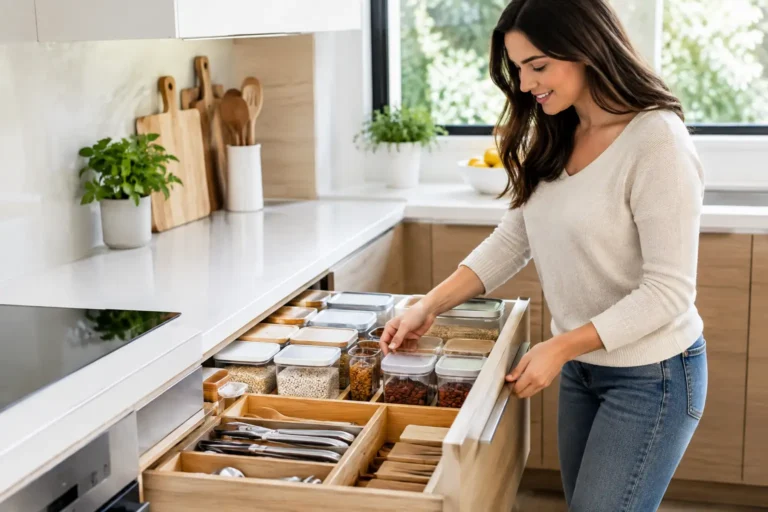
The kitchen drawer that will not close, the counter that keeps becoming a holding zone, the spice you buy twice because the first jar disappeared — none of that means you are careless or bad at being organized.
It means your kitchen is asking you to work harder than it should.
An efficient kitchen organization system is not a matching-container project. It is not about making your kitchen look untouched. It is about making the right thing easy to do when you are tired, rushed, feeding people, cleaning up, or just trying to get through a normal Tuesday.
You are not the problem.
The kitchen is giving you data.
When items repeatedly land on the counter, their homes may be too far away, too full, or too difficult to access. When unloading the dishwasher feels like a puzzle, storage may not match the way you actually use the room. When meal prep creates a mess that takes forever to reset, the work zones may be fighting each other.
Reality leads. The system conforms.
What an efficient kitchen organization system actually does
A useful kitchen system reduces friction at every stage: putting groceries away, preparing food, cooking, serving, cleaning, and resetting the room.
It should not require perfect habits, extra motivation, or a Sunday afternoon overhaul to keep working.
That distinction matters.
A beautiful pantry can still fail if breakfast foods are stored where the people eating them cannot easily reach them. A sparse counter can still be annoying if the coffee maker gets dragged out and put away several times a day. A drawer can look perfectly organized and still be wrong if you have to move three things to get to the one thing you use every morning.
Pretty is lovely.
Functional is the assignment.
The goal is not to own less just for the sake of owning less. The goal is to make frequently used items easy to find, easy to use, and easy to put back.
Some households need a generous supply of lunch containers. Others need room for baking tools, specialty cookware, or multiple people preparing food at the same time.
The right amount is determined by your actual life, not someone else’s kitchen.
Start with behavior, not bins
Before buying organizers, watch what happens in your kitchen during an ordinary week.
Where do the groceries land?
Where does the mail pile up?
Which drawer does everyone reach for first?
What gets left out after use?
What keeps migrating back to the counter no matter how many times you put it away?
Those patterns are not failures.
They are instructions.
The Reality Method starts with what is already happening. If an item repeatedly lands somewhere, I want to know why before I decide where it “should” live.
Ask practical questions.
Where do you make coffee?
Where do you pack lunches?
What do you reach for every day, every week, and only during holidays?
Who uses the kitchen?
What can they comfortably reach, lift, open, and put away?
A system that ignores physical capacity is not efficient.
Heavy appliances on a high shelf, dinner plates in a deep low cabinet for someone with knee pain, or a step stool required for everyday snacks all create unnecessary friction.
The best location is not always the most visually symmetrical one.
It is the one that works.
Map the kitchen into working zones
Most kitchens function better when storage follows activity instead of product category alone.
Cooking utensils belong near the cooktop.
Knives, cutting boards, mixing bowls, and prep tools should be close to the primary prep area.
Plates, glasses, and flatware should make sense in relation to the dishwasher, sink, and eating area.
But not every kitchen needs the same zones.
A household that orders takeout four nights a week may need a strong landing and leftovers zone.
A family making breakfast and packing lunches every morning needs easy access to cereal, lunch supplies, water bottles, and coffee.
Someone who bakes constantly may need flour, measuring tools, mixers, and pans working together in one area instead of scattered across the room.
The question is simple:
What task is this item supporting, and where does that task actually happen?
That is where it belongs.
Give the highest-use items the easiest access
Prime kitchen real estate is the easiest space to reach — usually waist to shoulder height and closest to the task being performed.
That space should go to the things you actually use.
This is where kitchens often get backward.
Special serving pieces occupy easy-access cabinets while the tools used every morning are crammed into awkward drawers. Holiday dishes live front and center while everyday food-storage containers are stacked somewhere inconvenient.
Move everyday plates, bowls, cups, cooking tools, and food-storage containers into the easiest locations.
Move occasional appliances, seasonal platters, and specialty tools to higher cabinets, lower cabinets, or secondary storage when appropriate.
And be honest about duplicates.
Two spatulas that both get used are not clutter.
Seven spatulas buried in a drawer might be.
The question is not whether you own “too much.”
The question is whether each item earns the space and access it consumes.
Design storage so putting things back is easy
A kitchen stays organized through returns, not sorting.
Every item needs a home that is obvious and easy enough to use at the end of a long day.
If putting away one pan requires moving three others, that pan is probably going to start living on the stove.
If a drawer is packed so tightly that everything catches when you open it, people are going to start dropping utensils wherever there is room.
If putting something away takes six steps, guess where it is going to live?
On the counter.
Make the right thing easy.
That means creating breathing room.
Use dividers when they prevent categories from collapsing into each other. Use clear boundaries for food storage, lunch supplies, baking tools, and cleaning supplies when those areas tend to blur together.
Containers can help, but only after the category, location, and capacity are clear.
Bins are not the system.
They are tools inside the system.
Labels can also help, especially in shared kitchens, homes with children, caregiving situations, or anywhere multiple people need to understand where things belong.
But a label cannot rescue a bad setup.
It cannot fix an overfilled cabinet, a category that makes no sense, or a system that asks too much of the person using it.
Build for low-energy days
The true test of a kitchen system is not whether it looks good right after you organize it.
It is whether it still works on a Wednesday night when everyone is hungry and nobody has extra bandwidth.
The system has to work on the days you can’t.
For many homes, that means creating a deliberate landing zone instead of pretending the counters will always stay completely empty.
A tray for coffee supplies, a contained fruit area, or one designated space for incoming groceries may support real life better than forcing everything behind a cabinet door.
It can also mean simplifying the cleanup path.
Keep dish soap, sponges, towels, and dishwasher supplies where they are actually used.
Store leftover containers close to the refrigerator or packing area.
Keep trash bags near the place where the trash gets taken out.
Every unnecessary step adds friction.
Every useful shortcut removes it.
There are trade-offs.
Open shelving makes things easy to reach, but it can create visual noise and requires more cleaning.
Deep drawers can be excellent for pots, pantry goods, or appliances, but they need enough structure to keep things from disappearing.
A system should reflect your tolerance for visual clutter, maintenance, lifting, bending, reaching, and decision-making.
Not an organizing trend.
Protect the system from incoming clutter
Kitchen clutter often enters through the door.
Groceries. Mail. School papers. Packages. Reusable bags. Random objects that belong somewhere else.
If the kitchen becomes the household’s default drop zone, reorganizing the cabinets will not solve the whole problem.
You have to look at the route the clutter is taking.
Where are incoming items landing?
Why there?
Where do they actually need to go next?
That may mean creating a package-management area, a small paper-processing station, a contained landing zone, or one place for items that need to leave the house.
The exact answer depends on the home.
The principle does not.
We read the room differently.
If something repeatedly lands in the same place, I do not automatically tell you to stop putting it there.
I want to know why it keeps happening.
Sometimes the answer is a new home.
Sometimes it is less inventory.
Sometimes the storage needs to move.
Sometimes the route through the house needs to change.
Reality has veto power.
Maintain with small resets, not major overhauls
Once the kitchen actually supports the way you live, maintenance should be relatively light.
You should not have to keep reorganizing the same space over and over.
A few minutes to clear the prep area, load the dishwasher, and return high-use tools should be more realistic than a weekly marathon.
Pay attention to early signs of friction.
A drawer getting harder to close.
A snack bin starting to overflow.
Food containers losing their home.
Something repeatedly ending up on the counter again.
That is data.
Adjust the system before the friction becomes a pile.
Households change.
Work schedules shift. Children grow. Caregiving changes. Diets change. Energy levels change. The way people use a room changes.
A durable system is allowed to evolve with them.
Your kitchen does not need to look untouched to be working well.
It needs to help you make breakfast, cook dinner, pack lunches, unload groceries, clean up, and find what you need without unnecessary searching or strain.
Can you find it in three seconds?
Will you actually put it back?
Does the system make your life easier?
That is the standard.
If your kitchen looks organized but still makes everyday life harder, the problem is not you.
The system needs to change.
