
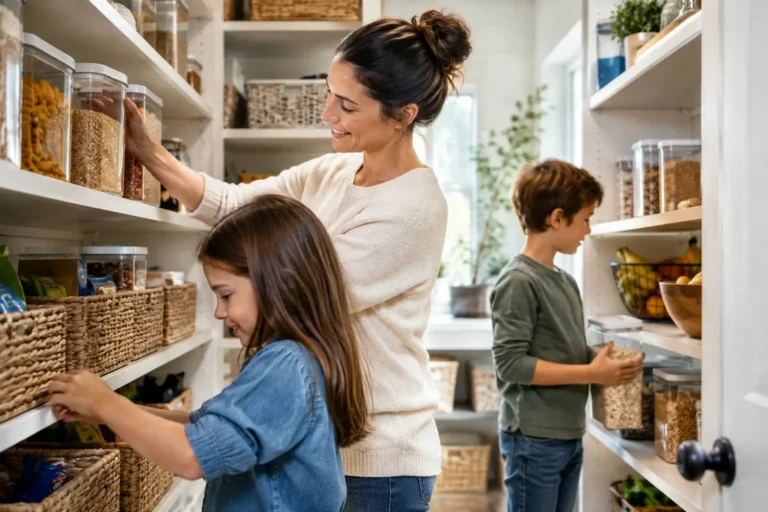
The cereal boxes are open, the snacks have migrated, and someone is asking what there is to eat while you are trying to get out the door.
That is not a discipline problem.
It is a pantry that is asking too much of the people using it.
Pantry systems for busy families should make the next right action obvious, especially at 7:15 a.m., 4:45 p.m., and every other low-bandwidth moment in between.
A beautiful pantry can still fail a household.
If lunch supplies are hard to reach, if backup food disappears behind everything else, or if one person has to reset the entire space after everyone uses it, the system is working against real life.
Pretty is lovely.
Functional is the assignment.
The goal is not a photo-ready shelf. The goal is less searching, less food waste, fewer duplicate purchases, and fewer tiny decisions when you already have enough to manage.
The pantry is giving you data.
Why Most Family Pantries Fall Apart
Families do not use pantries in neat, single-item categories.
They use them in bursts.
A child grabs a snack.
A parent unloads groceries between meetings.
Someone starts dinner while answering a text.
A caregiver needs to find something quickly without moving six other things first.
That is real life.
Conventional organizing often assumes people will slow down, decant every item, return everything precisely, and maintain a system with perfect consistency.
Some households genuinely enjoy that.
Many do not have the time, energy, interest, physical capacity, or desire to sustain it.
If a pantry system depends on ideal behavior, it will collapse under ordinary pressure.
The pile is not a personal failure.
It is data.
A countertop pile may mean the pantry has no landing zone for incoming groceries.
Half-empty snack boxes may mean children cannot access snacks independently.
Expired cans at the back may mean deep shelves are functioning as a hiding place instead of storage.
Before buying a single bin, look at what keeps happening and ask:
What is this space making people do?
Reality leads.
The system conforms.
Build Pantry Systems for Busy Families Around Real Use
A functional pantry starts with frequency, not labels.
The items used several times a day deserve the easiest access.
Things used once a month can live higher, lower, or farther back.
This sounds obvious, but it is where a lot of pantry systems go wrong.
Prime shelf space gets devoted to specialty ingredients, bulk backstock, or things that photograph well, while breakfast, lunch, and dinner essentials turn into a daily scavenger hunt.
That is backwards.
The best real estate belongs to the things you actually use.
Think in zones based on moments, not just food types.
A breakfast zone might include cereal, oatmeal, toast supplies, and grab-and-go bars.
A lunch zone can hold crackers, fruit cups, lunch supplies, and the refill items that tend to run out.
A dinner zone may group pasta, sauces, grains, and meal starters.
The point is not to create rigid rules.
It is to reduce the number of places someone has to look before they can complete a task.
For many households, four zones handle most of the daily traffic:
- A kid-accessible snack zone with simple choices and clear boundaries
- A breakfast and lunch zone for weekday speed
- A dinner-building zone for staples and meal components
- A backstock zone for extras, bulk purchases, and replacements
These zones should reflect your household, not a generic organizing diagram.
If you work from home and make coffee three times a day, coffee supplies may deserve the best real estate.
If your family relies on quick school lunches, lunch packing may be the central pantry function.
If someone in the household has dietary restrictions, keeping their reliable foods visible and separate may prevent frustration and accidental use.
The question is always the same:
What does this household actually do?
Start there.
Put Daily Items Between Knee and Shoulder Height
This is the working zone.
Reserve it for the food and supplies people reach for most often.
A busy family should not need a step stool to find granola bars or crouch on the floor to locate rice.
Heavy items belong lower for both safety and ease.
Upper shelves are better for occasional appliances, party supplies, seasonal baking ingredients, or extra backstock.
If the pantry is tall and narrow, use the upper space deliberately instead of filling it with things that will disappear for a year.
Accessibility is not a luxury feature.
It determines whether a system can survive a Tuesday.
Design for Independent Access, Not Perfect Compliance
If children are old enough to get their own snack, the pantry should make that possible without creating a daily avalanche.
That may mean one lower bin or shelf with preapproved choices instead of giving them access to every snack in the house.
The container is not the system.
The boundary is.
For adults, independent access means using categories that match the way the household actually thinks.
“Lunch stuff” can be more useful than some overly precise category nobody remembers.
The best label is the one people understand without asking.
Avoid categories so narrow that every grocery trip turns into a debate about where something belongs.
A system needs enough flexibility to survive changes in brands, quantities, schedules, and actual life.
“Quick snacks,” “baking,” and “dinner helpers” will often hold up better than ten tiny categories with no room for variation.
Make the right thing easy.
Make Restocking Easy Enough to Happen
A pantry is not organized once.
It is maintained through dozens of small actions.
That means restocking needs a home, a visual cue, and as little unnecessary effort as possible.
Use containment where it solves a real problem.
Bins can keep packets from scattering.
Turntables can make deep corners usable.
Dividers can stop bags from collapsing into each other.
But containers also consume space and create another task if every item has to be removed from its packaging first.
For a household that shops in bulk, switches brands often, or simply does not want to decant everything, original packaging may be the more functional choice.
Bins are not the system.
They are tools inside the system.
The test is simple:
Can a tired person put groceries away correctly in a few minutes?
If the answer is no, simplify.
Create a defined backstock area instead of spreading extras across every shelf.
When duplicate cereal, extra pasta, or reserve snacks all have one obvious place, the active area stays easier to read.
It also becomes easier to see what you already have before buying more.
That matters.
Buying another jar because the first one disappeared is not a shopping problem.
It is a retrieval problem.
Deep shelves need special attention.
Without pull-out access or some kind of structure, food disappears behind the front row.
Grouping similar items in open containers lets you pull the entire category forward.
If you do not want bins, use a simple front-and-back rule:
Active items in front.
Unopened replacements behind them.
It is not fancy.
It works.
Plan for the Friction Points You Already Know
Every home has predictable failure points.
The question is whether the pantry acknowledges them.
Maybe grocery bags sit on the floor for two days because there is no clear place for overflow.
Maybe the chip shelf becomes chaos because different-sized bags will never stack neatly.
Maybe someone opens a new box before finishing the old one.
Maybe snacks keep migrating to the counter because the pantry location is inconvenient.
These are not mysteries.
They are design prompts.
If bags are the problem, a large open bin or vertical divider may work better than careful stacking.
If duplicates are the problem, use one open package at a time and keep reserves behind or above it.
If groceries linger, create one temporary intake zone so the food is at least contained and visible until it gets fully put away.
If something repeatedly lands in the same place, do not automatically assume the person needs to stop doing it.
Ask why it keeps happening.
Sometimes the answer is a different home.
Sometimes it is less inventory.
Sometimes the route needs to change.
Sometimes the pantry is simply too far from where the task happens.
We read the room differently.
Follow the Route People Already Travel
Do not force a pantry to solve every food-related task just because it technically stores food.
If lunch packing always happens on the counter, keep lunch bags and containers near that counter.
If coffee happens across the room, move the coffee supplies closer to where the coffee actually gets made.
If children grab snacks on their way out the door, the most logical snack zone may not be the prettiest shelf.
Storage should follow activity.
The goal is not to make every category live in one perfectly contained pantry.
The goal is to reduce friction across the entire process.
Where does this task happen?
What does the person need next?
What would make returning the item easier?
Those questions matter more than whether a category looks aesthetically perfect.
Know When the Problem Is Capacity, Not Organization
Sometimes the pantry is not failing because it is disorganized.
It is failing because there is simply too much inventory for the amount of storage available.
Reality has veto power.
No label can create shelf depth.
No basket can turn a crowded cabinet into a walk-in pantry.
That does not automatically mean you need a renovation.
It may mean adjusting purchase quantities, moving less-used appliances elsewhere, reducing duplicate stock, or assigning backstock to a nearby cabinet, garage shelf, or utility area.
The right answer depends on the household.
A family that shops weekly needs a different setup than one that buys in bulk.
A home with toddlers needs different access than one with teenagers.
A household managing caregiving, changing work schedules, or lower-energy seasons needs fewer maintenance steps, not more.
The system has to work on the days you can’t.
At Pacific Organizers, the standard is not whether a pantry looks controlled five minutes after a reset.
It is whether the people using it can find what they need, put things back without fighting the space, and keep moving through daily life with less friction.
Can you find it in three seconds?
Will you actually put it back?
Does the system make your life easier?
That is the standard.
Your pantry does not need to impress anyone.
It needs to help the hungry person find food, help the tired person put groceries away, and help the household keep moving when life is full.
Build for that version of your family.
The real one.
That is the system that has a chance of lasting.
